At Schindler House, a different idea of home.
A nearby West Hollywood architecture guide to Schindler House’s shared live/work origins, the relationship between rooms and gardens, and planning a thoughtful visit.
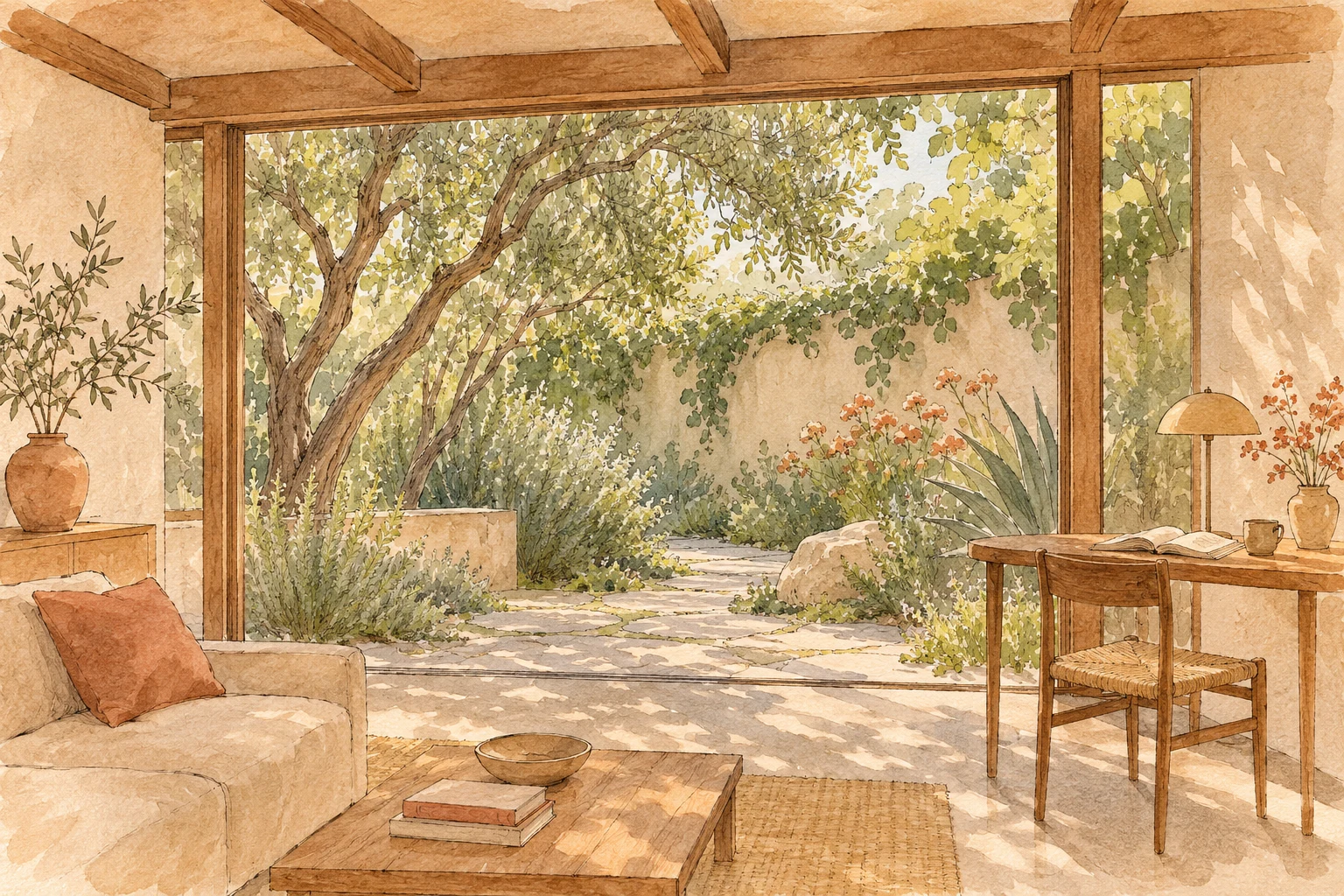
A floor plan is also a proposal about how people might live together. It decides where a conversation can continue, where someone can withdraw, and whether the garden feels like another part of daily life or a view beyond the glass. Schindler House offers a nearby way to think about those choices.
At 835 North Kings Road in West Hollywood, the 1922 house is the headquarters of the MAK Center for Art and Architecture. For Beverly Grove-area readers, it is a local architectural outing with a subject that reaches beyond style: how a home balances individual space and shared life.
A cooperative home, not just a modern look
MAK Vienna’s historical account describes Rudolph M. Schindler’s design as a cooperative live/work space for two couples. Rudolph and Pauline Schindler joined Clyde and Marian Chace to build a dwelling with a guest unit. Construction followed in 1922; the building remained Schindler’s home and studio until his death in 1953.
The same account describes outdoor courts used for dining and children’s play, and terraces that became settings for performances. Those uses make the design more interesting than a collection of modernist features. The house accommodated work, companionship, family routines and cultural life, with the outdoors participating in that arrangement.
For someone comparing homes today, the useful starting point is the household, not the image. Who needs quiet at the same time? Which activities can comfortably overlap? A generous shared space and a genuinely private place do different jobs, even when both look appealing in a listing.
Look for the transition, not only the opening
MAK’s history emphasizes the house’s reconsideration of indoor and outdoor, public and private space. One way to explore that idea is to notice transitions: what happens between a room and a court, between a gathering place and a retreat, or between the street and domestic life.
These are observation prompts, not a description of a route we have personally walked. During a visit, ask where light draws attention and where an edge creates separation. Does a change in enclosure make an adjoining area feel connected, sheltered or distinct? Looking this way can be more revealing than simply deciding whether a plan is open.
Bring that attention back to your own priorities without treating a historic experiment as a ready-made renovation plan. An attractive relationship between spaces does not answer questions about weather protection, present-day building requirements, maintenance or the needs of a different household.
A historic house with an ongoing cultural role
The MAK Center’s mission and history connect today’s exhibitions and programs to the artistic exchange that took place around Rudolph and Pauline Schindler. The organization works across art and architecture, using historic sites as settings for contemporary inquiry rather than presenting the buildings only as isolated objects.
Its Companion Tours offer interpretive audio by artists, architects and writers. The Center describes exercises and storytelling as well as historical readings. That distinction is helpful: an artist’s interpretation and a documented historical claim are different kinds of material. The tours are available online; for an in-person visit, the Center asks listeners to bring headphones or keep the volume considerate.
Plan for the house you mean to visit
As checked November 24, the local MAK Center hours page lists Schindler House visiting hours Wednesday through Sunday, 10 AM–5 PM, with $10 general admission. It also lists closures on Thursday, November 26 and Friday, November 27 for Thanksgiving. Regular weekly hours should not be read as an exception to those closures.
The visitor guide recommends advance timed-entry tickets and restricts posed photography and equipment during public hours. Check separate arrangements before planning professional images.
Match the route to the visitor
The Center describes a ground-floor property approached over compact dirt, with pavers at the entrance and changes between dirt, grass and concrete. It notes roughly one-inch transitions between some surfaces and says alternate entries are available where a doorway is narrow. It also allows passenger loading and unloading in the driveway for visitors with access needs, while stating that designated parking areas are not provided.
Those details make a useful pre-visit conversation, not a blanket accessibility guarantee. If you or someone joining you needs a particular route, clearance or assistance, contact the Center before choosing a time. Ask how the arrival and entry arrangements fit those needs, rather than relying only on the description “ground floor.” Our practical takeaway is to plan the route as carefully as the ticket. The thresholds that make an architectural visit interesting can also affect how comfortably someone moves through it.
Bring home a better brief
Afterward, write down one spatial relationship you would like in a home and one practical question it raises. That is a useful beginning for a conversation, not evidence that another property shares Schindler’s authorship or design history. Our home-history research guide explains how to investigate those separate claims. Our period-revival guide offers another nearby architectural context. The point is not to pick a winning style, but to become more specific about what makes a place work for you.
Go to the source
- MAK Vienna: Schindler House historical account (not used for current hours) ↗
- MAK Center: mission, history and current cultural role ↗
- MAK Center: interpretive Schindler House Companion Tours ↗
- MAK Center: local hours, address, admission and 2026 holiday closures ↗
- MAK Center: ticket planning, visitor guidelines, photography and accessibility ↗
Five official MAK Center and MAK Vienna pages checked November 24, 2026. The linked historical essay and local visitor, hours, mission and audio-tour pages display no article publication dates. This is an architecture guide, not a new opening or a firsthand visit. Current logistics come from the local MAK Center pages; the different hours printed on MAK Vienna’s historical page are not relied on. The local hours page lists November 26–27, 2026 Thanksgiving closures. Access descriptions are the Center’s published guidance, not a route audit or individual suitability assessment. Ticket-calendar availability, purchases and audio playback were not tested; confirm current arrangements directly before visiting.
Editorial architectural history and original observation prompts, not an assessment of any home, a design or renovation specification, an attribution, valuation or determination of historic protections or development rights. A historic example does not establish what is permitted or suitable at another address. Our editorial policy.
A property question?
Michael and Gabriel can help you organize the real estate questions and identify the next conversations to have.
Contact Michael + Gabriel →